
How to Choose the Right Air Duct Cleaning Company in Quincy
Most homeowners shop for duct cleaning the way they’d shop for a haircut: lowest price wins, and you hope for the best. In Quincy that approach costs people real money, because the trade has almost no licensing barrier in Massachusetts. Any person with a van and a shop vac can legally call themselves a duct cleaning company. There’s no state license specific to the trade, which means the questions you ask before booking are your only quality filter. Here’s how to use them.
Does Massachusetts license duct cleaning companies?
No. Massachusetts does not issue a license specific to air duct cleaning, so a company’s state paperwork tells you very little about whether they can actually clean a duct system. That’s the uncomfortable fact at the center of this whole decision. The credential that matters is voluntary, and you have to check it yourself.
What you can verify:
- Insurance and bonding. Ask for a certificate of insurance before anyone touches your system. A legitimate operator provides it without hesitation.
- NADCA membership. The National Air Duct Cleaners Association sets equipment and process standards, and members commit to a code of ethics. Membership is a signal that a company chose to be held to something.
- Individual certification. NADCA certifies technicians through an exam process. Ask whether the person doing the work is certified, not just whether the company “is NADCA.”
- The directory check. Look the company up directly in NADCA’s public member directory rather than trusting a logo on a website. Logos are easy to copy.
What NADCA membership does not verify: it doesn’t guarantee a fixed price, it doesn’t cover every technician on every job, and it doesn’t replace your own questions about equipment. Treat it as one filter, not the whole sieve. In a Quincy triple-decker or an older single-family with original ductwork, the equipment questions below matter just as much.
Which equipment should a Quincy duct cleaning company actually use?
Ask two specific questions on the phone: what agitates the debris, and what captures it. A company that can’t answer both clearly is probably running a shop vac and an air compressor, and you’ll know it within a minute of the call.
Here’s the equipment vocabulary worth knowing before you dial:
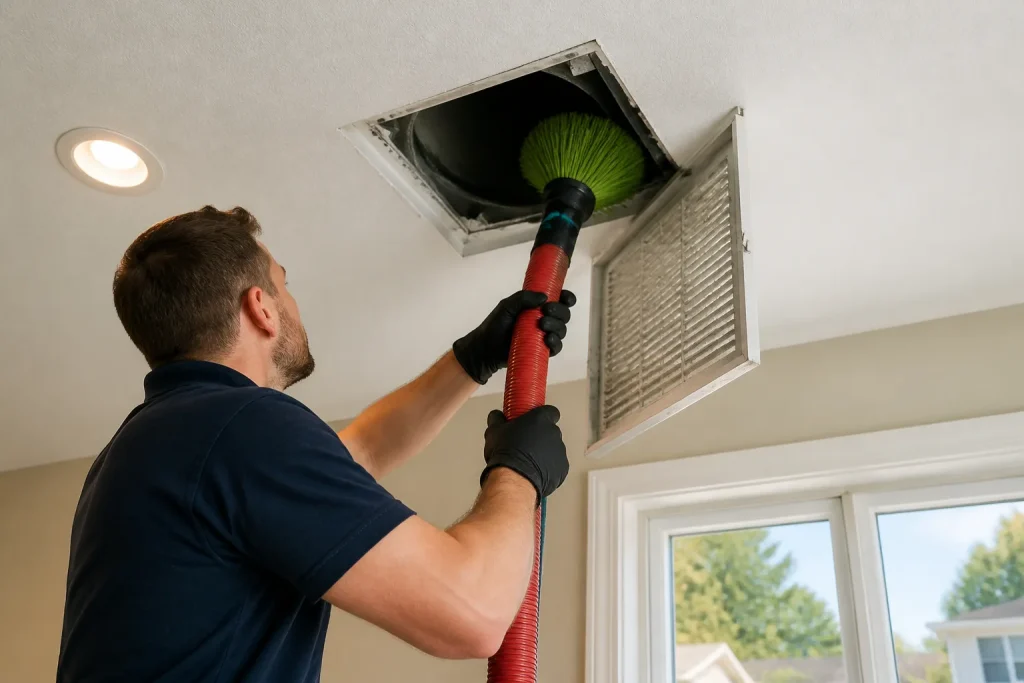
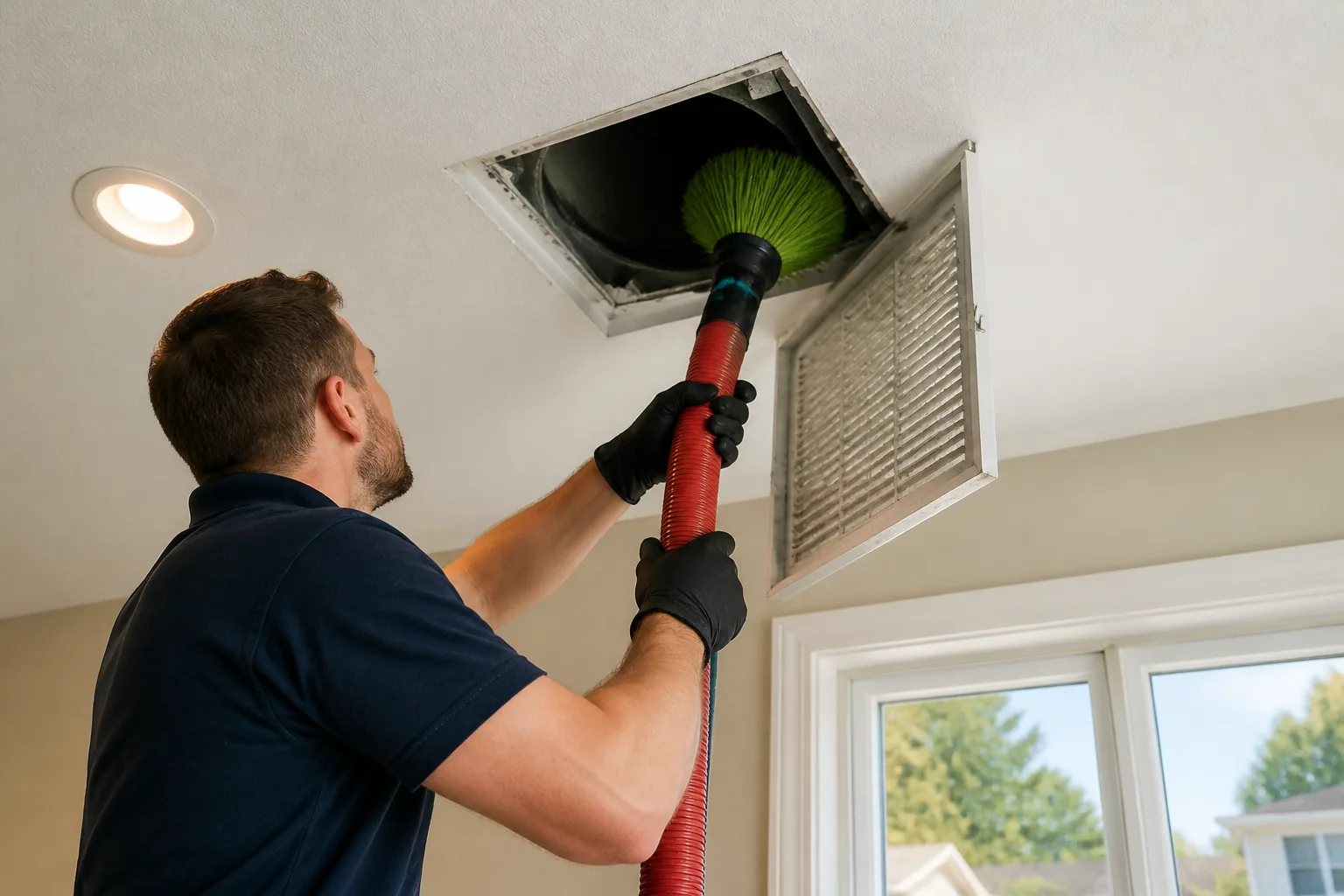
- Rotary brush systems (Rotobrush). These mechanically agitate debris off duct walls. Air-only methods blow dust loose but often leave the stuck-on layer behind. A rotary brush is the difference between sweeping a floor and aiming a fan at it.
- HEPA vacuum equipment (Nikro). HEPA-rated vacuums capture dislodged particulates instead of recirculating them into your living room. If the capture end is weak, the whole job is theater.
- Negative-air machines (Abatement Technologies). These maintain containment during the work, keeping the system under slight negative pressure so debris travels toward the machine rather than into your kitchen. Abatement Technologies equipment is built for remediation-grade projects, which tells you something about the jobs a company expects to handle.
- Truck-mounted negative air. For larger jobs, a truck-mounted unit provides stronger suction than a portable. Ask whether the company has one or accesses one for heavier contamination.
Agitation without capture is a dust storm. Capture without agitation leaves the debris where it sat. You want both, and the brand names above are a reasonable shorthand for a company that takes the process seriously.
Why does duct repair capability matter in Quincy’s older housing?
Because Quincy has a lot of older housing stock, and older ductwork develops problems that cleaning alone can’t fix. Disconnected joints, crushed sections behind finished walls, leaky seams at fittings. A cleaning-only company runs a brush through, collects a check, and leaves the leak exactly where it was. The debris comes back because the system is still pulling unfiltered air through every gap.
A company that also diagnoses and repairs ductwork operates differently. During the cleaning, technicians note disconnected runs, damaged flex sections, and leaks at the plenum. You get a report that says what’s wrong instead of just what was cleaned. One visit can tell you whether your ducts need cleaning, repair, or both, and that’s a genuinely more useful answer than a cleaning-only operation can give you.
This matters most if you’ve recently had HVAC work done, renovated a floor, or noticed rooms that never seem to heat or cool properly. Those symptoms often trace back to duct problems, not equipment problems. If your system is losing air through a disconnected joint, no amount of cleaning will fix the pressure imbalance. The repair does.
What are the red flags in a duct cleaning quote or sales call?
Several, and most show up in the first two minutes. Watch for these:
- Price-per-vent models. A flat fee per vent sounds simple, but it rewards the company for counting vents, not for doing the work. Whole-system pricing agreed before work starts is clearer and harder to inflate once the technician is in the house.
- Same-day urgency pressure. A phone quote that becomes a “today only” deal when you hesitate is a sales tactic, not a scheduling convenience. Legitimate work doesn’t expire at 5pm.
- Refusal to explain the process. If the person on the phone can’t tell you what equipment they’ll use and how they’ll contain the dust, they either don’t know or don’t want you to.
- No mention of negative pressure containment. A company that doesn’t bring containment equipment is planning to blow debris around your home and hope you don’t notice.
- Teaser pricing on the phone that grows into a much larger invoice on site. Ask for the written estimate range before booking, and ask what could change it.
We’ve watched homeowners in Quincy get caught by the bait-and-switch more than once. The fix is simple: one flat price per system, agreed before work starts, no per-vent pricing, and before-and-after photos of your own ducts.
How do you read a post-job report to verify the work was done?
A rubber-stamp invoice says “duct cleaning performed” and asks for a signature. A legitimate report tells you what was found and what was done. Here’s what separates the two:
- Before-and-after photos of your actual ducts. Not stock images. Not a generic gallery. Your return plenum, your supply runs, your plenum interior.
- Findings listed by location. “Heavy debris in the main trunk,” “disconnected flex run at the second-floor register,” “mold-adjacent staining near the air handler.” Specifics, not adjectives.
- Repair recommendations separate from cleaning. If the technician found a problem, it should be documented, not mentioned verbally and forgotten.
- Equipment used. The report should name the tools, because the tools are the proof the process was real.
- Access points documented. Every register and return should be accounted for. If your report shows three vents cleaned and you have eleven, ask why.
If you get a one-line invoice with no detail, you have no way to know what happened behind your walls. That’s not a report. That’s a receipt.
When to call a pro (and when it can wait)
If you’re seeing visible dust blowing from registers right after a filter change, if a recent renovation sent drywall dust through the system, if allergy symptoms cluster in one room, or if your dryer takes two cycles to dry a load, it’s time for a professional look. A dryer vent packed with lint is a documented fire risk, and clearing it at the surface doesn’t solve the problem. For routine maintenance on a clean, well-sealed system, you have more time.
Related services in Quincy: if your diagnostic turns up a clogged dryer line, dryer vent cleaning handles it as its own job. If you’re starting from scratch on the cleaning side, our air duct cleaning page covers the process end to end. And if you just want to understand what a full system clean involves in this market, start at Duct Cleaning Quincy.
One more thing worth saying plainly: if the technician arrives and the equipment looks like it came from a hardware store aisle, that’s your answer about the company. You don’t need to be an expert to notice a shop vac where a HEPA unit should be.
The Bottom Line
You can’t verify a duct cleaning company through the state, so verify it through the equipment, the NADCA directory, the questions they’re willing to answer, and the report they hand you afterward. Ask about Rotobrush and Nikro equipment and negative-air containment. Ask whether they repair ductwork or only clean it. Ask for a flat price per system, in writing, before work begins. If you’re in Quincy and need help, Duct Cleaning Quincy offers free estimates. Call Quincy homeowners can reach us at (855) 632-0215. We answer 24/7. Fast dispatch from 7am to 7pm, Sunday through Friday. Our technicians have up to 14 years of experience, and the written estimate sets the final price, every time.
Frequently Asked Questions
Most whole-system cleaning jobs in the Quincy market run somewhere in the low-to-mid hundreds of dollars, and the written estimate sets the final price. Expect a range, not a per-vent figure, because per-vent pricing rewards counting vents rather than doing the work. Ask what could change the quote before you book. Call (855) 632-0215 for an exact quote. Estimates are free.
Because they often skip the equipment. A shop vac and an air compressor cost a fraction of a Rotobrush rotary brush system and a Nikro HEPA vacuum, and the results look similar in photos taken from a distance. They aren’t similar in your ducts. The cheapest quote usually means no mechanical agitation and no proper containment. Call (855) 632-0215 for an honest quote. Estimates are free.
Ask for before-and-after photos of your own ducts, findings listed by location, and the equipment used. A legitimate post-job report is specific and photo-documented. A rubber-stamp invoice with no detail behind it tells you nothing. Call (855) 632-0215 for an exact quote. Estimates are free.
For most homes it’s a multi-year interval, not an annual event, and the timing depends on your system, pets, recent renovations, and whether your ductwork is sealed properly. A well-sealed system with a good filter stays clean far longer than a leaky one. If you’ve had a renovation or noticed a pressure drop, that’s the trigger, not the calendar. Call (855) 632-0215 for an exact quote. Estimates are free.
Written by the team at Duct Cleaning Quincy.
Need Air Duct Cleaning Help?
Call Duct Cleaning Quincy - licensed & insured, here with fast help in Quincy.
(855) 632-0215