
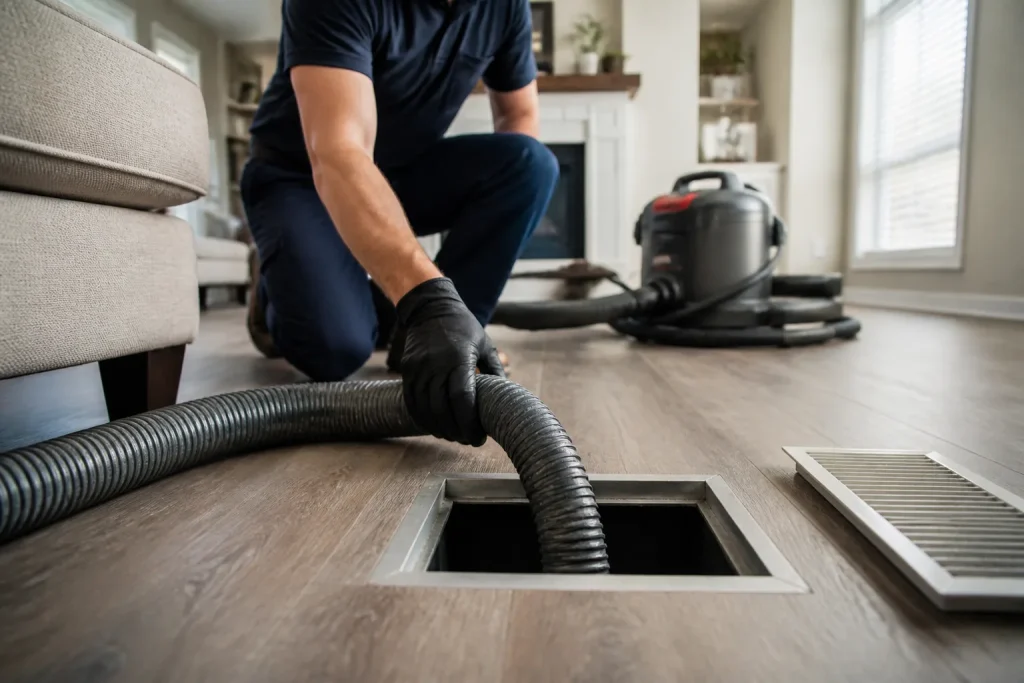
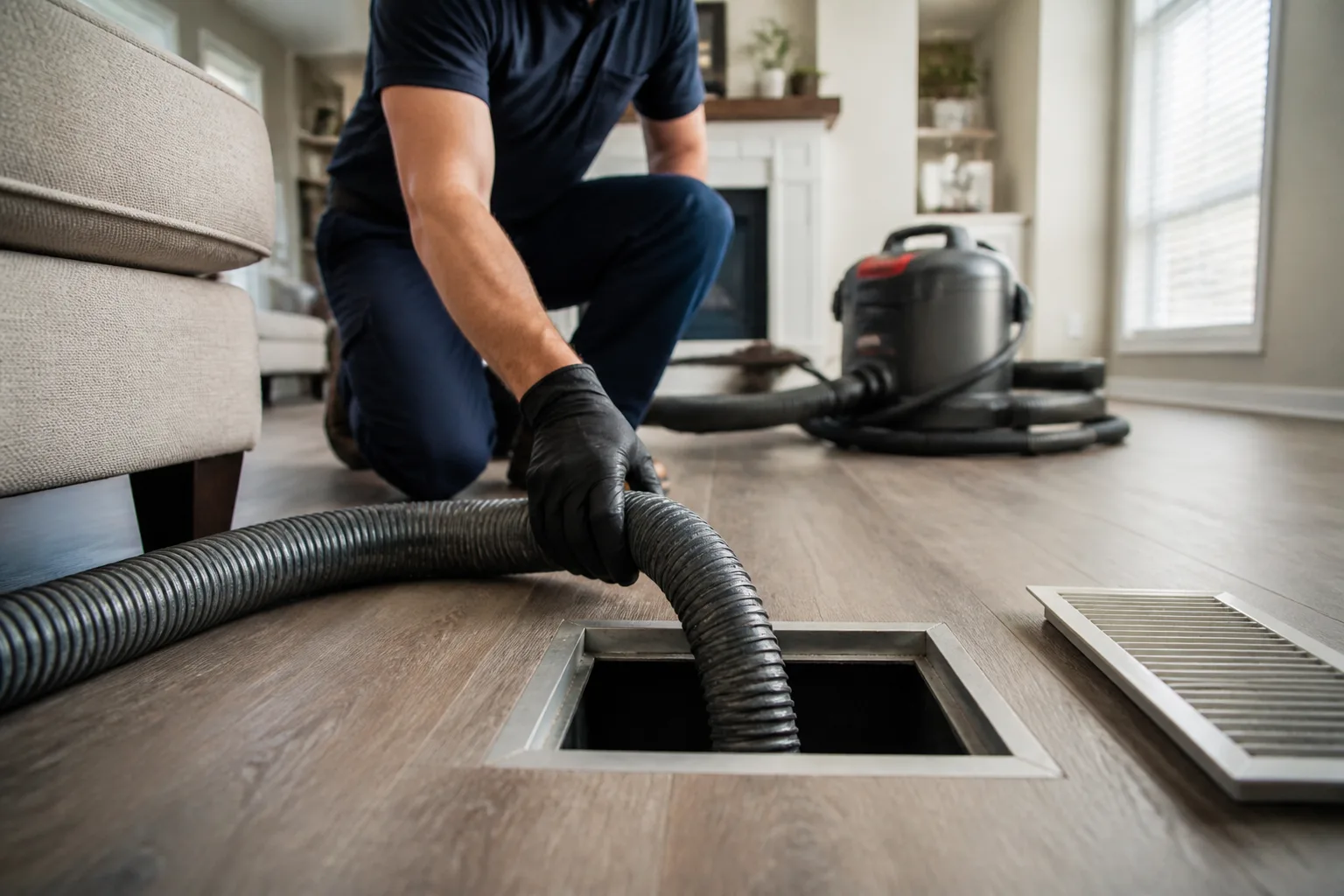
Emergency Air Duct Cleaning Near Me: What Quincy Homeowners Should Do First
Here’s the mistake we hear about most: a homeowner sees water creeping toward a return register in the basement, and flips on the fan for a minute to “see if it’s okay.” That single minute can pull contaminated air into every room in the house before anyone arrives. If your ducts are in a genuine emergency, the first move is almost always to shut the system off and leave it off. If you’d rather not sort through it alone, call (855) 632-0215.
We answer 24/7. Fast dispatch from 7am to 7pm, Sunday through Friday.
Key Takeaways
- Only three situations are true duct emergencies in Quincy: flood or sewage intrusion into ductwork, fire or smoke contamination, and confirmed rodent nesting inside the system.
- Most duct problems that feel urgent – pet hair, musty smells, a dusty register – can wait for a scheduled appointment.
- Running the HVAC fan after contamination is the single most common way a small problem becomes a whole-house one.
- Ask any company whether they carry negative-air containment equipment before you book an emergency call.
- Take photos before cleaning starts. Any insurance claim depends on it.
What Counts as a Real Duct Emergency in Quincy?
A real duct emergency is one where contamination is actively spreading through the system or the ductwork itself is compromised. Three scenarios meet that bar. Everything else, however alarming it feels, can wait for a scheduled visit.
The three genuine emergencies:
- Flood or sewage intrusion. Groundwater, a backed-up drain, or a failed sump can push water and waste into return ducts. Sewage carries bacteria that no ordinary cleaning removes.
- Fire or smoke contamination. Soot and combustion byproducts settle inside ductwork and continue off-gassing long after the fire is out.
- Confirmed rodent nesting. Droppings, nesting material, and the insects that follow them are a contamination event, not a housekeeping issue.
Situations that feel urgent but usually aren’t: a dusty register after a renovation, a faint musty smell from a floor vent, a dryer that takes two cycles instead of one. Quincy’s older housing stock, with its share of cast-iron drains and basement mechanical rooms, makes the flood scenario more common than people expect. If your ducts have been through a water event, that’s the moment to schedule rather than wait, but it isn’t a reason to panic-spin the fan.
What Should You Do in the First Hour of Each Emergency?
Turn the HVAC system off at the thermostat first, then handle the source of the contamination if you safely can. The system stays off until a technician clears it in all three emergency types. This is the point most homeowners get wrong, and it’s the difference between a contained problem and a whole-house cleanup.
Here’s the sequence, broken out by scenario:
- Flood or sewage: Kill power to the HVAC equipment at the breaker if water is near it. Shut off the water source. Move anything dry out of the affected rooms. Leave the fan off. Do not run a shop vac over wet duct openings – you’ll aerosolize what’s in there.
- Fire or smoke: After the fire department clears the structure, keep the system off. Soot is fine and travels easily. Opening windows is fine; running air through the ducts is not.
- Rodent nesting: Don’t disturb the nest. Droppings become airborne when swept or vacuumed with ordinary equipment. Keep the fan off and keep pets and kids out of the room with the affected register.
Once the source is stopped, take photos of everything. More on that below, because it matters for insurance. Then call. We answer 24/7, and a call outside dispatch hours is booked into the next opening, Sunday through Friday, 7am to 7pm.
What Should You Ask Before Booking an Emergency Call?
Ask four questions, and listen for equipment names in the answers. A company that can’t describe its containment setup before arriving is a company that will clean your ducts the way it cleans every other job – which is not what a contamination event requires. In our experience, the answers separate remediation-capable shops from routine cleaners fast.
The questions:
- “Do you use negative-air containment?” This is the big one. Negative-air machines hold the work area under pressure so dislodged particles get captured instead of pushed into living space. If the answer is vague, that’s your answer.
- “What vacuum equipment do you run?” You want to hear about HEPA-rated capture, not a shop vac and a promise. Nikro HEPA vacuums are built for exactly this.
- “Do you do duct repair, or only cleaning?” Flood and rodent damage often disconnect or tear duct sections. If the company only cleans, you’ll be making a second call.
- “Will you photograph the ducts before you start?” Any company confident in its work says yes without hesitating.
We run Rotobrush rotary brush systems for mechanical agitation of debris and Abatement Technologies negative-air equipment for containment. That Abatement equipment is the same class of machinery used in commercial remediation, and it’s the reason we can take on post-fire and mold-adjacent jobs that a standard duct cleaning setup isn’t built for. For more on our full service lineup, see our Quincy page.
When Is It Not an Emergency? (And Why That Matters)
Most of what brings people to a search for emergency duct cleaning is a nuisance, not a hazard. Knowing the difference saves you money and gets you a better appointment. Routine buildup from pet hair, seasonal dust, and ordinary household debris responds to the same cleaning process whether it happens today or next week.
Signs you can schedule instead of panic:
- A visible dust film on registers after a remodel (schedule after the drywall dust settles, not before)
- Mild musty odor with no water event behind it
- A clothes dryer taking noticeably longer to dry a load – that’s a lint buildup signal, and it belongs on your list for dryer vent cleaning
- New construction or a recent HVAC replacement, where a first cleaning makes sense
One honest note: a duct cleaning company that treats every call as an emergency is telling you something about its pricing model. We’d rather tell you your situation can wait a few days than sell you urgency you don’t need.
When to call a pro: if you can’t tell whether your situation is contamination or ordinary buildup, that’s the call to make. One visit can tell you whether your ducts need cleaning, repair, or both.
Related services in Quincy: air duct cleaning and dryer vent cleaning.
What Documentation Should You Get for an Insurance Claim?
Ask for photos of the contamination before any cleaning begins, plus a written statement of what the technician found and the equipment used. Insurance adjusters work from evidence, and once the ducts are clean the evidence is gone. This is the one area where the paperwork matters as much as the work.
What to gather from the visit:
- Before-and-after photos of your own ducts, taken by the technician
- A written description of the contamination type and the affected sections
- The scope of work performed, including any duct repair
- Equipment used – Abatement Technologies containment and Nikro HEPA capture carry weight in a remediation claim
Take your own photos too, before anyone arrives. Water lines on ductwork, soot staining, visible nesting material – shoot it all, with something for scale. Insurers see a lot of claims, and the file with thorough documentation moves faster than the one with a verbal description. If your home has Honeywell or Aprilaire air quality equipment tied into the system, note that as well; a technician who knows those brands can tell you whether any of it needs attention after the contamination event.
If the work involves repairing damaged duct sections rather than just cleaning, that’s a separate scope and worth confirming in writing. See what a full Duct Cleaning Quincy visit covers to understand the difference.
The Bottom Line
Nine times out of ten, the right first move in a duct emergency is the simplest one: shut the system off and leave it off. Then take photos, then call a company that can describe its containment equipment before it arrives. In Quincy, the flood scenario deserves real caution given how many basements house mechanical equipment behind older drains, and post-fire or rodent contamination isn’t a job for a shop vac. Our technicians have up to 14 years of experience, and we carry the Abatement Technologies and Rotobrush equipment these jobs require. If you’re in Quincy and need help, Duct Cleaning Quincy offers free estimates – call (855) 632-0215.
Frequently Asked Questions
Most jobs are priced per system by a written estimate rather than per vent, and the number depends on the system size and the contamination type. Call (855) 632-0215 for an exact quote – estimates are free.
No. Running the fan after water or sewage intrusion can distribute contaminated particles into every room in the house. Keep the system off until a technician clears it. Call (855) 632-0215 and we’ll walk you through it.
Ask for before-and-after photos of your own ducts, taken on site. Any company confident in the work provides them without prompting. Call (855) 632-0215 to schedule.
Yes. We find and fix leaks, damaged sections, and disconnected ducts as part of the same visit. Most cleaning-only companies leave those behind. Call (855) 632-0215 for a free estimate.
Written by the team at Duct Cleaning Quincy.
Need Air Duct Cleaning Help?
Call Duct Cleaning Quincy - licensed & insured, here with fast help in Quincy.
(855) 632-0215